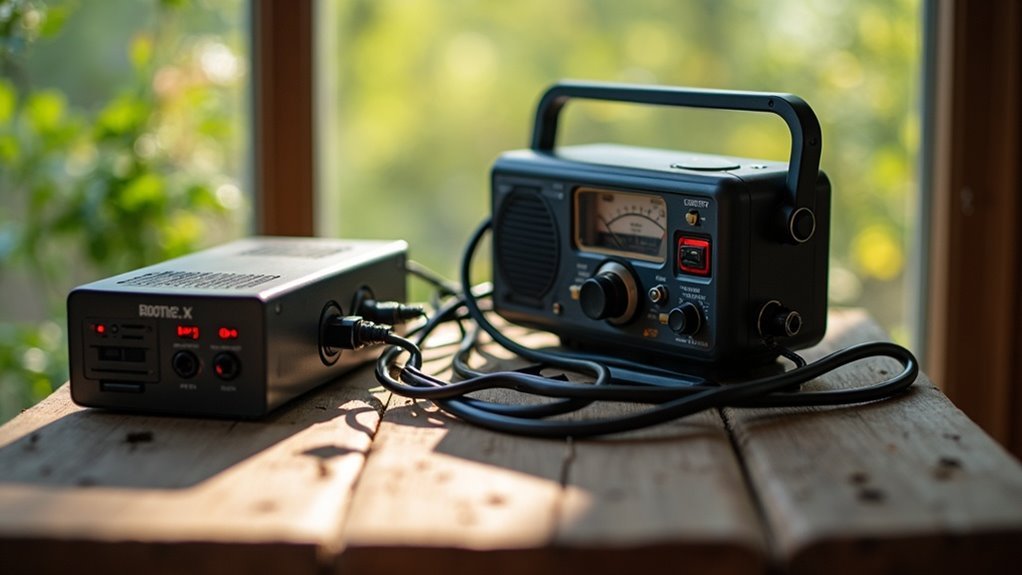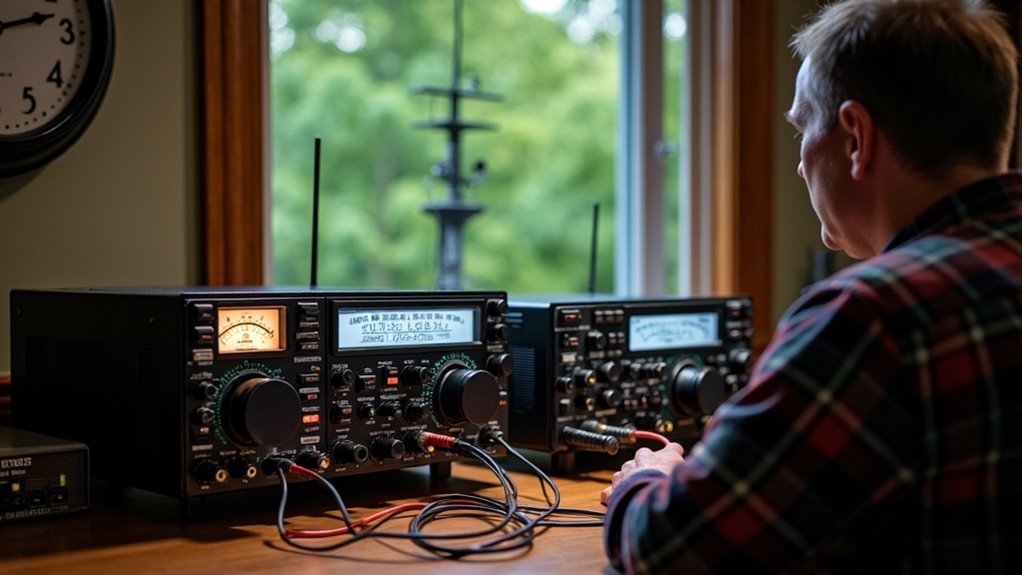
To use cross-band repeaters legally in the context of survivalism and prepping, you need a Basic+ license and must comply with FCC regulations. Start by configuring your dual-band radio with VHF and UHF frequencies, ensuring you set the primary VFO for VHF simplex and the secondary for UHF. Regularly announce your call sign every 10 minutes, and conduct test transmissions to ensure your equipment is functioning properly. When using the UHF side, keep power output minimal to reduce interference, which is crucial in emergency situations where clear communication is essential. There’s much more to know about effective setups and practices to enhance your communication skills, especially when preparing for emergencies.
Key Takeaways
- Obtain a Basic + license for operating cross-band repeaters and ensure compliance with applicable regulations for emergency communication.
- Set primary and secondary VFOs correctly for VHF and UHF simplex channels to ensure effective communication during critical situations.
- Announce your call sign every 10 minutes during transmissions to maintain legal identification and transparency in your communications.
- Use minimal power output on the UHF side to reduce interference with other communications, especially in emergency scenarios where clear signals are crucial.
- Conduct test transmissions to confirm operational status and adherence to legal requirements, ensuring your equipment is ready when it matters most in survival situations.
Understanding Cross-Band Repeat Functionality
Cross-band repeat functionality can be a valuable asset for survivalists and preppers looking to enhance communication capabilities in various emergency situations.
By utilizing a crossband repeater, you can configure dual-band radios to receive on one band and retransmit on another, effectively extending your communication range when traditional methods may fail. This setup often involves handheld transceivers (HTs) on UHF and a base station on VHF, allowing for improved mobility and better access to signals in challenging environments.
Utilizing a crossband repeater enhances communication range by allowing dual-band radios to operate seamlessly between different frequencies.
It’s crucial to remember that while cross-band operation can boost your communication reach, adhering to FCC regulations is essential. This includes auto-identifying on both bands and transmitting your assigned call sign.
Additionally, proper placement of antennas and managing power output are key to ensuring optimal signal quality during critical times.
Licensing Requirements for Cross-Band Operation
To operate a cross-band repeater legally, it’s essential to be aware of the licensing requirements set forth by the FCC. Here’s what you need to know:
- You must hold at least a Basic + license to use cross-band repeaters.
- The Control Operator is responsible for announcing their call sign every 10 minutes.
- Advanced certification is required for remote control operation of cross-band repeaters.
Understanding these licensing requirements ensures compliance with regulations and enhances your operating experience.
Remember, while there’s no clear distinction between cross-band and in-band repeaters, following these guidelines keeps you within legal boundaries.
In survival and prepping scenarios, effective communication can be crucial.
Therefore, being knowledgeable about these requirements not only prepares you to operate equipment correctly but also ensures that you can maintain connectivity in various situations.
Always stay informed and compliant to maximize your preparedness efforts.
Operating Procedures for Cross-Band Repeaters
When using cross-band repeaters for survival communications, it’s crucial to ensure your dual-band radio is set up correctly for emergency situations.
Select a VHF channel for receiving and a UHF channel for transmitting, as this distinct band operation is essential for effective communication during a crisis.
As a Radio Operator, you must identify your station every 10 minutes on both bands, ensuring your call signs are transmitted to maintain accountability.
Conduct a test transmission to confirm that both VHF and UHF signals are relayed effectively, which is vital for coordinating with your group.
Familiarize yourself with local repeater guidelines, and use minimal power output on the UHF side to reduce interference.
This practice will help ensure reliable communication from your base station while remaining compliant with regulations, ultimately enhancing your preparedness for any survival scenario.
Legal Considerations and Compliance
When engaging in survivalism and prepping activities, it’s crucial to be aware of legal considerations and compliance, especially in relation to communication methods.
If you’re using a cross-band repeater for emergency communications, you must comply with FCC regulations to avoid fines and penalties. This includes identifying yourself with your assigned call sign every 10 minutes and at the end of each transmission.
Familiarizing yourself with these identification requirements is essential for maintaining compliance and ensuring that all operators are traceable in case of emergencies.
FCC Regulations Overview
Understanding FCC regulations is crucial for anyone interested in utilizing cross-band repeaters legally in the context of survivalism and prepping.
Adhering to the following key points ensures responsible communication:
- Identify your station with your call sign every 10 minutes during transmission, which is vital for accountability during emergencies.
- Confirm that both input and output frequencies adhere to licensing requirements; an Advanced license is necessary for in-band repeaters, while a Basic + license suffices for cross-band operations.
- Employ auto-ID systems to ensure compliance, particularly for older cross-band repeaters that may struggle with proper transmission identification.
Identification Requirements Explained
Proper identification is a fundamental requirement for operating cross-band repeaters legally, just as having the right tools and knowledge is essential for survivalism and prepping.
The FCC mandates that you identify your station every 10 minutes during transmissions, similar to how preparedness requires regular check-ins on your supplies and plans. This identification applies to both the transmitting and receiving devices, which parallels the need to ensure that all aspects of your survival gear are ready and operational.
Each amateur station, including both your base station and handheld transceiver, must independently transmit its assigned call sign, much like having a reliable communication plan in place for when you need to reach out for help or coordinate with others in a crisis.
Failure to meet these identification requirements could lead to legal issues, just as neglecting your prepper duties could result in being unprepared during an emergency.
If you’re using remote control to operate the repeater, ensure ID timers are activated, akin to having a checklist for your emergency supplies.
Equipment Setup for Effective Cross-Band Communication
To ensure effective cross-band communication for survival situations, it’s essential to set up your equipment properly.
Effective cross-band communication is vital in survival situations; proper equipment setup is crucial for success.
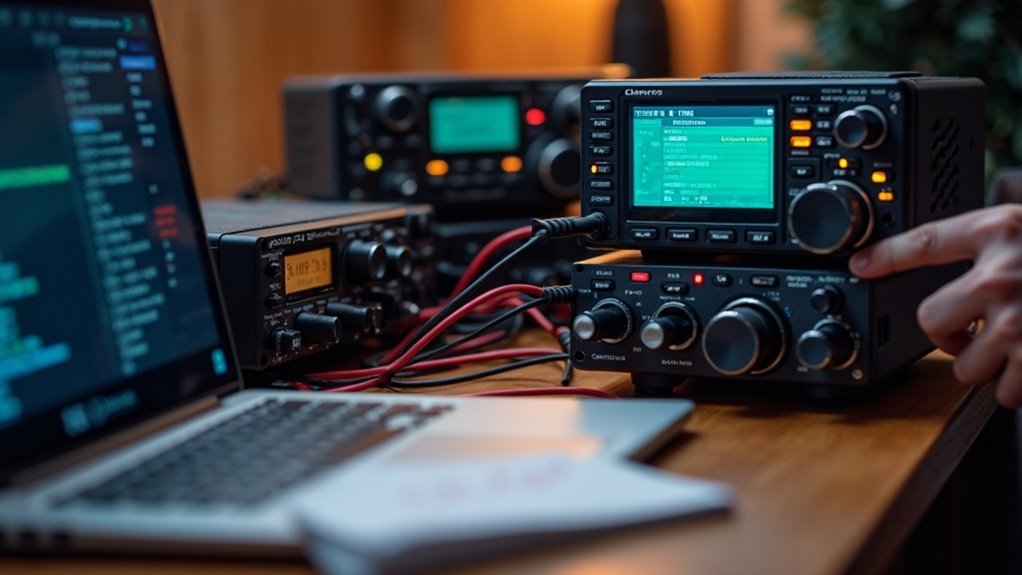
Begin with a dual-band base radio that operates on both VHF and UHF frequencies, which are critical for emergency communications.
Follow these steps:
- Configure your primary VFO (Variable Frequency Oscillator) for a VHF simplex channel, which is often used for local communication, and set your secondary VFO for a UHF simplex channel, useful for longer distances and specific situations.
- Consult your radio’s manual for the correct key combination to enable crossband repeating, allowing for seamless communication between the two bands.
- Equip your setup with high-gain antennas for both bands to significantly improve signal quality and extend your communication range during emergencies.
Lastly, conduct test transmissions to confirm that both channels are operational and that your radio effectively relays signals between the VHF and UHF bands, ensuring you remain connected when it matters most in a survival scenario.
Community Engagement and Best Practices
Engaging with your local survivalist and prepping community opens up knowledge-sharing opportunities that can enhance your understanding of essential skills and strategies.
Collaborating with fellow preppers allows for effective problem-solving and helps you navigate challenges more efficiently.
Networking within the community fosters improvement, ensuring you remain prepared while maximizing the benefits of your resources and equipment.
Knowledge Sharing Opportunities
While participating in local survivalist and prepping groups, you can discover numerous opportunities for knowledge sharing that enhance your understanding of essential skills and resources.
Engaging with fellow preppers allows you to:
- Discuss best practices for emergency preparedness and sustainable living.
- Participate in workshops or training sessions focused on survival techniques and strategies.
- Access resources like articles and webinars from reputable survivalist organizations.
Collaborative Problem Solving
Collaborative problem solving within the survivalism and prepping community enhances your understanding of essential skills and strategies for self-sufficiency.
Engaging with local prepper groups and online forums fosters knowledge sharing about food storage, emergency preparedness, and sustainable living practices.
By collaborating with experienced preppers, you can grasp the legal requirements for acquiring and using survival supplies in compliance with local regulations.
Community feedback aids in troubleshooting challenges, improving setups, and ensuring effective communication during emergencies.
Sharing personal experiences leads to better techniques and operational strategies, while group discussions clarify resource management and identification practices, ultimately promoting a responsible and informed approach to preparedness.
Networking for Improvement
Networking within the survivalist and prepping community can significantly enhance your skills and knowledge in emergency preparedness and self-sufficiency. Engaging with others can help you understand best practices and compliance with local regulations.
Here are some ways to network for improvement:
- Join local survivalist and prepping groups to share insights on food storage, homesteading, and emergency planning.
- Participate in online forums for troubleshooting tips and collaborative learning experiences regarding gear and techniques.
- Attend community events or meetups to practice skills and receive constructive feedback on your prepping strategies.