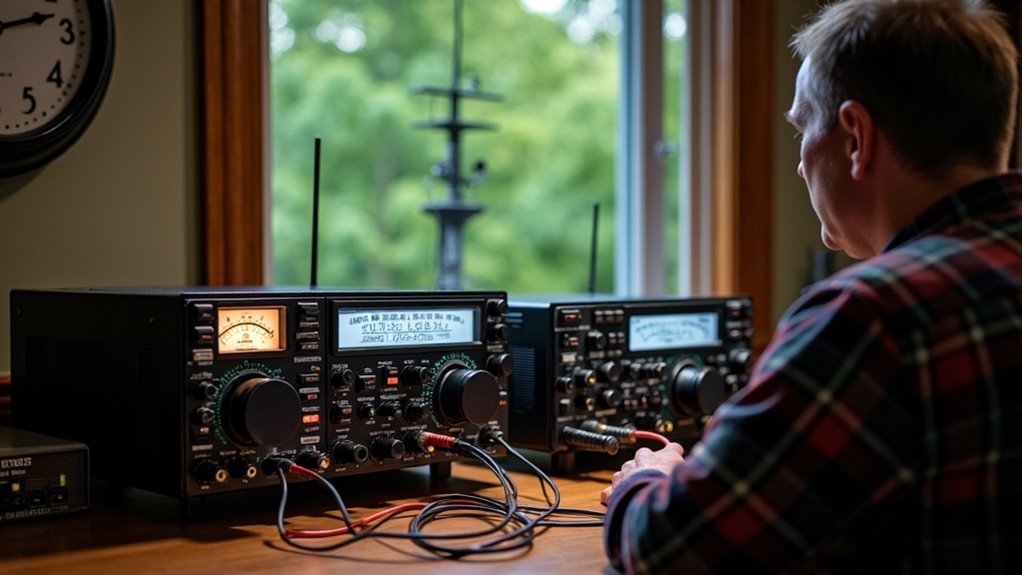
To practice radio brevity and clarity in a survival context, focus on delivering concise messages using standard phrases and the phonetic alphabet. Prioritize essential information related to your environment and safety, and aim for clear pronunciation by slowing down your speech. Engage in regular drills and simulate emergency scenarios to build confidence and teamwork among your group. Record your transmissions to identify areas for improvement and seek feedback from experienced operators for better clarity. Stick around to discover more effective strategies and techniques to enhance your communication skills in critical situations!
Key Takeaways
- Conduct regular radio drills to practice delivering survival messages in under 30 seconds, enhancing brevity and clarity for emergency communication.
- Use standard phrases and the phonetic alphabet to reduce misunderstandings and improve message transmission in challenging environments, such as during a crisis or disaster.
- Record and review your transmissions to identify areas for improvement, ensuring clear communication skills essential for survival situations.
- Engage in simulated training scenarios focused on emergency preparedness to practice effective questioning techniques and quick decision-making under pressure.
- Seek feedback from experienced survivalists and operators to refine message structure and foster continuous improvement in communication skills critical for prepping and survival.
Understanding the Importance of Brevity and Clarity
When communicating over the radio in survival and prepping scenarios, brevity and clarity are crucial. Short messages reduce misunderstandings, ensuring vital information is shared quickly. Clear transmissions lessen airwave congestion, allowing for efficient communication among groups.
Research indicates that messages longer than 30 seconds raise the risk of miscommunication, so keeping messages concise is vital. Using standardized phrases enhances clarity and removes ambiguity.
Proper training in these principles can significantly reduce communication errors, highlighting the importance of mastering radio brevity and clarity for effective survival operations.
Techniques for Crafting Concise Messages
To craft concise survival messages, use standard phrases everyone understands to save time and minimize confusion.
Prioritize essential information, especially in emergencies, to ensure clarity and effectiveness in your communication.
Standard Phrases Utilization
Effective communication in survival and prepping scenarios hinges on your ability to use standard phrases that enhance clarity and brevity. Incorporate terms like “Roger” for acknowledgment and “Over” to signal message completion, streamlining your communication.
Use the “break” command to separate topics, ensuring clarity in busy environments. When audio quality falters, spell out critical information using the phonetic alphabet to avoid confusion.
Familiarize yourself with common lingo related to survivalism, as it boosts understanding and efficiency. By practicing structured messages with essential information first, you’ll sharpen your skills in survival communication while maintaining clarity and brevity in every transmission.
Prioritize Essential Information
Prioritizing essential information is crucial for effective radio communication in survival and prepping scenarios. Identify the core message and include only necessary details.
Use standard phrases for quick communication, avoiding lengthy explanations. Break complex information into smaller segments for clarity.
Regularly practice radio checks to confirm understanding and enhance concise communication skills. Review and refine your delivery to eliminate filler words.
The Role of the Phonetic Alphabet in Communication
When you communicate over radio in survival situations, using the phonetic alphabet can make all the difference in clarity and understanding. It standardizes letter spelling, which is vital in noisy or chaotic environments.
Here’s why it matters for preppers and survivalists:
- Reduces Errors: Transmitting critical information like location coordinates and gear specifications becomes clearer, minimizing the risk of misunderstandings.
- Enhances Efficiency: Operators can convey important details quickly without ambiguity, which is crucial during emergencies or when coordinating with a team.
- Universal Standard: Endorsed by ICAO and ITU, it’s recognized globally, making it essential for communication in various survival scenarios, whether in the wilderness or during an urban crisis.
Mastering the phonetic alphabet not only improves your communication skills but also ensures you’re understood when it counts the most.
Practicing Clear Pronunciation
Mastering the phonetic alphabet is essential for effective communication in survival situations, but practicing clear pronunciation elevates your skills even further.
To enhance your pronunciation, slow down your speech slightly; this allows you to articulate your thoughts clearly and minimizes the risk of miscommunication in critical scenarios. Regularly record your transmissions and listen for areas that may need improvement, especially when conveying important survival information.
Engage in tongue twisters or specific vocal exercises to refine your enunciation skills, ensuring that your messages are conveyed accurately. Practicing in front of a mirror can help you observe your mouth movements, which is vital for proper articulation of words.
With consistent effort, your clarity over communication devices will improve, making your survival messages more effective and easily understood during emergencies.
Utilizing Effective Questioning Strategies
To gather crucial information quickly in survival situations, you should formulate clear questions that can be answered with a simple “yes” or “no.”
Prioritize your inquiries based on urgency, especially during emergencies, to ensure you obtain the most vital details first.
Engaging in simulated training scenarios can also help you hone your questioning techniques and adapt to various survival and prepping contexts effectively.
Formulating Clear Questions
How can you ensure your questions about survivalism and prepping are clear and effective? To formulate clear questions in this context, consider these strategies:
- Be Specific: Use precise terminology related to survivalism, such as “What are the best methods for long-term food storage?” to directly address the information you need, thereby reducing confusion.
- Choose the Right Question Type: Use closed questions for straightforward answers, like “Is this water purification method safe?” and open questions for in-depth insights when necessary, such as “What are the key factors to consider when choosing a bug-out location?”
- Standardize Terminology: Utilize commonly accepted survivalist terms to ensure clarity, such as “EDC” for everyday carry, to minimize miscommunication.
Remember to actively listen to ensure your queries are well-received and think before you speak to maintain clarity.
Practicing these techniques will enhance your communication skills, especially when discussing crucial survival strategies under pressure.
Prioritizing Information Gathering
Effective questioning is crucial for gathering vital information, especially in survival situations. When using two-way radios in prepping scenarios, prioritize closed questions that provide specific, concise answers.
Focus on critical details first, particularly during emergencies, to streamline communication. Utilize standard phrases and terminology recognized by your team to reduce confusion while collecting information.
Engage in scenario-based training exercises to hone these techniques, improving your ability to retrieve information quickly and accurately in real-time. Regularly review your questioning strategies based on feedback from seasoned operators, ensuring continuous improvement in your communication effectiveness.
Clarity and efficiency are your primary objectives in preparedness contexts.
Engaging in Simulated Training
While you might think clear communication comes naturally, engaging in simulated training exercises is essential for mastering effective questioning strategies in survival scenarios.
These sessions help you practice crucial skills that enhance your radio use during high-pressure situations, such as emergencies in the wild or during a crisis.
Focus on these key strategies:
- Use closed questions for immediate clarity, ensuring you’re gathering precise information quickly.
- Prioritize questions based on the urgency of the survival situation, enabling you to make informed decisions rapidly.
- Familiarize yourself with standard phrases and protocols relevant to survival communications.
Regular practice in a controlled environment boosts your confidence and communication skills, preparing you for real-life emergencies.
Regular Practice for Continuous Improvement
To enhance your radio communication skills for survival situations, regular practice is crucial. Schedule weekly sessions to engage in radio drills that focus on delivering concise messages in under 30 seconds. Participate in scenario-based exercises that simulate real-life emergency situations, honing your ability to communicate clearly and directly. Utilize recorded transmissions for analysis, allowing you to identify areas needing improvement. Incorporate feedback from experienced operators in survival scenarios to refine your message structure and eliminate unnecessary words.
Here’s a simple table to guide your practice:
| Practice Element | Purpose |
|---|---|
| Radio Drills | Improve brevity and clarity |
| Scenario-based Training | Simulate real-life survival situations |
| Feedback Sessions | Enhance message effectiveness |