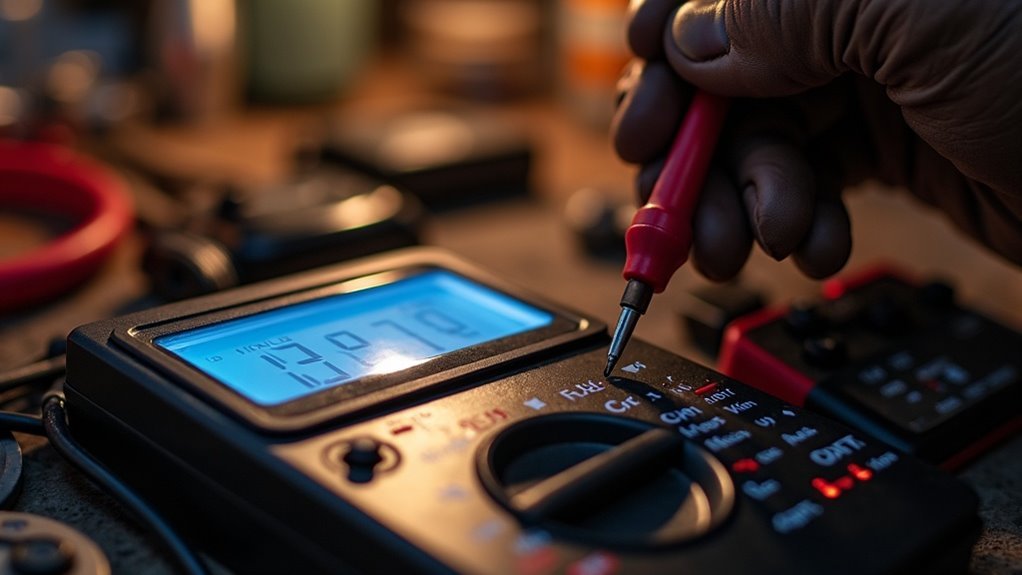
To monitor battery voltage for your survival gear, begin by disconnecting any chargers to ensure you get accurate readings. Utilize a multimeter set to DC voltage, ideally in the 20-volt range. Firmly connect the probes to the battery terminals—red for positive and black for negative. Take note of the voltage levels and compare them against standard thresholds to evaluate the battery’s health, which is crucial for reliable operation in emergency situations. Regular checks and documenting trends are vital for maintenance and preparedness. Stay informed on essential tips for managing and troubleshooting your battery performance to ensure your survival equipment is always ready when you need it.
Key Takeaways
- Use a multimeter to regularly check battery voltage, ensuring accurate readings by disconnecting the charger; a reliable power source is essential for survival situations.
- Record voltage readings in a preparedness notebook to track trends and identify potential issues over time, which is crucial for maintaining essential equipment.
- Set alerts for low battery thresholds specific to battery types (e.g., 3.2V for lithium-ion) to prompt timely maintenance and ensure you have power when you need it most.
- Clean battery terminals to prevent corrosion, which can affect voltage readings and overall performance, ensuring your gear remains functional during emergencies.
- Investigate any sudden voltage drops under load, as this may indicate aging batteries or poor connections, critical for the reliability of your survival equipment.
Understanding Battery Voltage Measurement
When measuring battery voltage in a survivalist or prepping context, it’s essential to understand that the voltage displayed reflects the total potential at the terminals, which can be influenced by factors such as internal equivalent series resistance (ESR) and the battery’s charge state.
For reliable measurements, always disconnect any charger, as its voltage can obscure the true battery voltage. Utilize a multimeter set to the DC voltage range, ideally within 20 volts, to ensure accurate readings. Ensure that the multimeter probes make solid contact with the battery terminals to prevent inaccurate or zero readings.
Keeping an eye on voltage thresholds, like 11-10 volts for car batteries, is crucial for determining when a battery needs charging or when it may be time for replacement—important factors for maintaining your preparedness supplies.
Tools Required for Battery Voltage Testing
To effectively test battery voltage for your survival gear, you’ll need a few essential tools, with a multimeter being the most critical. A reliable multimeter typically costs between $10 to $20 and should be set to the DC voltage range for accurate readings. For household batteries, use the 20-volt setting, while larger batteries, such as those used in solar power systems or emergency equipment, may require higher ranges. Verify correct probe connections by placing the black probe in the “Comm” port and the red probe in the “V” port. Proper probing technique involves securely contacting the battery terminals to ensure accurate readings. Regular voltage checks can help prevent unexpected failures, ensuring your emergency supplies are always ready when you need them.
| Tool | Purpose | Price Range |
|---|---|---|
| Multimeter | Measure battery voltage | $10 – $20 |
| Probes | Connect to battery terminals | Included |
| Safety Goggles | Protect your eyes during testing | $5 – $15 |
| Notebook | Record voltage readings | $2 – $10 |
| Battery Tester | Alternative voltage testing tool | $15 – $30 |
Step-by-Step Guide to Using a Multimeter
To effectively use a multimeter for measuring battery voltage in survival situations, start by selecting the appropriate settings on the device to ensure you’re prepared for any emergency.
Next, connect the probes correctly to guarantee accurate readings, which can be crucial when assessing the reliability of your power sources.
Finally, interpret the voltage displayed to evaluate the battery’s condition, helping you make informed decisions about your preparedness and resource management.
Selecting Multimeter Settings
Selecting the correct multimeter settings is crucial for accurately measuring battery voltage, especially in survival situations where reliable power sources are essential. First, ensure your multimeter is set to the DC voltage setting, indicated by a “V” with straight lines. Next, adjust the voltage range to 20 volts, which is suitable for most household batteries that you may rely on during emergencies. Confirm that the black probe is connected to the “Comm” port and the red probe to the “V” port to ensure proper function.
| Setting Type | Description | Example Value |
|---|---|---|
| Voltage Setting | DC voltage for batteries | V (Straight) |
| Probe Connection | Black to “Comm”, Red to “V” | Correct |
| Voltage Range | Typically set to 20 volts | 20V |
Understanding these settings will help you maintain your equipment and ensure you have reliable power when you need it most.
Connecting Probes Correctly
Properly connecting the probes of your multimeter is essential for accurate battery voltage measurements, especially in survival situations where reliable power sources are crucial.
Start by plugging the black probe into the “Comm” port and the red probe into the “V” port. Set the multimeter to the DC voltage setting, marked by a “V” with horizontal lines.
In a survival scenario, you’ll need to identify the battery state by locating the positive and negative terminals; connect the red probe to the positive terminal and the black probe to the negative terminal.
Firmly press the probes against the terminals to ensure stable contact, as maintaining a reliable connection can be vital in the field.
Check the multimeter display for accurate readings, and be cautious to avoid overload or open circuit conditions, ensuring your gear is functioning properly for your prepping needs.
Interpreting Voltage Readings
While monitoring battery voltage is a crucial skill for any survivalist or prepper, accurately interpreting the readings demands careful attention.
Once you’ve connected your multimeter, observe the output voltage displayed on the screen. For standard household batteries, a reading close to the nominal voltage signifies that the battery is functioning properly, which is vital in emergency situations. If the voltage dips below the expected value, it could indicate that the battery is drained or malfunctioning, potentially jeopardizing your preparedness.
A zero reading could point to poor contact or an open circuit, so it’s important to double-check your probe connections. Ensure that the black probe is on the negative terminal and the red probe is on the positive terminal to obtain accurate results.
Grasping these nuances is essential for effective voltage monitoring and maintaining reliable power sources when every resource counts.
Interpreting Voltage Readings
How can you accurately interpret voltage readings from a multimeter to assess the health of batteries crucial for your survival gear?
Start by ensuring a solid connection; poor probe contact can skew your results, which is especially important when every ounce of power counts in a survival situation.
For car batteries, a reading above 12.6V indicates a full charge, while below 11.8V suggests it’s time to recharge before heading into the field.
A car battery reading over 12.6V means it’s fully charged; below 11.8V indicates a need for recharging before your adventure.
Household batteries should ideally show around 1.5V; values under 1.2V indicate depletion, and you’ll want to replace or recharge them before they fail you.
For higher voltage batteries, employ a voltage divider to ensure your multimeter can handle the readings without risk of overload.
If you see a “1” on the display, adjust to a higher voltage setting for accurate measurements to ensure your equipment is always ready when you need it the most.
Common Battery Voltage Thresholds
Understanding common battery voltage thresholds is crucial for ensuring the reliability of your survival equipment.
For lithium-ion batteries, a fully charged state is around 4.2V, with a critical cutoff at 3.0V to 3.2V.
Nickel-cadmium and nickel-metal hydride cells peak at 1.4V, and operating below 1.0V can present risks in survival scenarios.
Lead-acid batteries should read 12.6V to 12.8V when fully charged, while discharging below 11.8V can lead to damage, jeopardizing your emergency power supply.
Lithium iron phosphate cells reach full capacity at 3.6V to 3.65V and shouldn’t drop below 2.5V to ensure they remain reliable for your preparedness needs.
Alkaline batteries are generally considered depleted around 0.9V to 1.0V, so monitoring these thresholds is vital for maintaining your gear in a survival situation.
Regular Maintenance and Monitoring Tips
Regular maintenance and monitoring of battery voltage are crucial for ensuring the reliability and longevity of your power sources in survival situations. Frequently check your battery voltage with a multimeter, making sure it remains within the manufacturer’s recommended range.
Establish a low battery threshold alert, such as 3.2V for lithium-ion batteries, to preemptively address potential performance issues before they arise. Keep a log of voltage readings to track trends and anticipate when replacements may be necessary, ensuring you’re always prepared.
Establish a low battery threshold alert to proactively manage performance and ensure you’re always prepared for any situation.
Utilize a voltage divider circuit to measure voltage safely without exceeding your Arduino’s 5V limit, which is useful for monitoring in various prepper projects.
Lastly, clean battery terminals regularly to prevent corrosion, as this can distort voltage readings and compromise the overall performance of your batteries, crucial for maintaining your preparedness equipment.
Troubleshooting Low Voltage Issues
When battery voltage drops unexpectedly, it’s crucial for survivalists and preppers to act swiftly to diagnose the problem.
Start by checking your voltage with a multimeter. If it reads significantly below the minimum—12.0 volts for lead-acid batteries or 3.0 volts for lithium-ion—immediately investigate poor connections or damaged wiring. These issues can lead to increased internal resistance, ultimately resulting in a dead battery, which can be a critical failure during a survival situation.
While under load, keep an eye out for voltage drops that may indicate aging or diminished capacity, as a reliable power source is essential for preparedness.
Consider installing a voltage alarm to prevent deep discharge, ensuring your batteries remain functional when you need them most.
Lastly, if you notice any discrepancies in voltage readings, inspect for a reverse current protection diode that could be causing additional voltage drops in your circuit.
Maintaining your battery health is a key aspect of effective prepping.