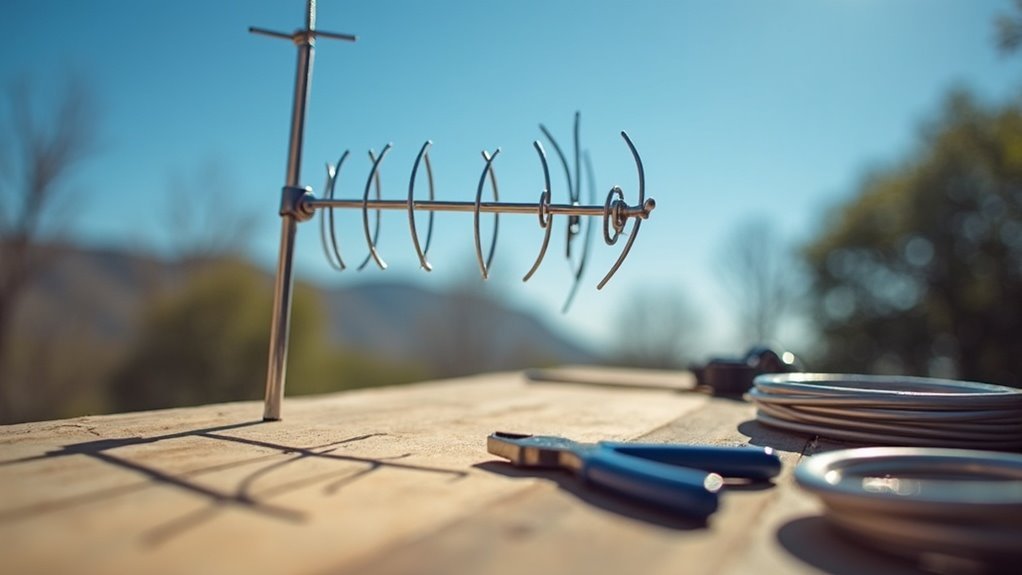
To build a tape measure dipole antenna for your survival and prepping needs, start by cutting two 19-inch pieces of a Stanley Fat Max tape measure for the driven elements. Assemble a sturdy PVC boom to ensure durability in various conditions, and attach the elements using hose clamps, maintaining a 1-inch gap between the driven elements for optimal performance. Solder the antenna relocation cable securely, ensuring solid connections that can withstand the test of time. Test the SWR with an analyzer and fine-tune as needed for the best reception. This cost-effective design not only provides great performance but also equips you with valuable skills and knowledge for emergency communication. As you continue your prepping journey, you’ll uncover even more tips and techniques to enhance your survival capabilities.
Key Takeaways
- Gather essential materials including two 19-inch tape measure pieces, connectors, PVC pipe, and tools such as a soldering iron and heat gun, which can also be useful for survival situations.
- Cut and assemble a durable PVC frame for the antenna boom, ensuring it is robust enough to withstand outdoor elements.
- Carefully disassemble the tape measure and cut elements to specified lengths for the Director, driven, and reflector components, keeping in mind that versatility in tools can be critical in prepping scenarios.
- Solder connections meticulously, ensuring solid joints for optimal conductivity, and use a heat gun for insulation to protect against the elements.
- Test the antenna using an analyzer to achieve a low SWR, adjusting elements as needed for optimal performance, which can be crucial for reliable communication in survival situations.
Materials Required
To construct a tape measure dipole antenna for survival communication, you’ll need a few essential materials that are easy to source and can be vital in emergency situations.
Begin with two 19-inch pieces of a tape measure, ideally the Stanley Fat Max, which will serve as your driven element for effective signal transmission. Additionally, include two 4-inch segments for structural support, ensuring durability in outdoor settings.
Start with two 19-inch Stanley Fat Max tape measure pieces as your main elements, plus two 4-inch segments for added stability.
Heavy-duty 5/8 inch shrink wrap is crucial for insulating connections and preventing electrical conduction between the antenna elements, which is particularly important when operating in variable environments.
Be sure to have an antenna relocation cable or a DIY equivalent to connect to your radio for reliable communication during a crisis.
Lastly, gather sandpaper for smoothing edges, electrical solder, a soldering iron for secure connections, a heat gun for applying shrink wrap, and Flex-Seal to enhance assembly and insulation.
These materials will help you create a robust and efficient antenna system for survival scenarios.
Cutting the Elements and Assembling the Frame
After gathering all the necessary materials, you can proceed to cut the elements and assemble the frame of your tape measure dipole antenna, an essential tool for effective communication in survival situations.
Cut two PVC pipe pieces to lengths of 17 1/2 inches for the boom and 7 inches for support. Disassemble your tape measure, then cut the Director to 35 1/8 inches, driven elements to 17 3/4 inches, and the reflector to 41 3/8 inches.
Sand the ends of the tape measure elements for safety before soldering, ensuring that your equipment is reliable when you need it most.
Assemble the boom using PVC connectors and glue for stability, as a sturdy structure is crucial in outdoor environments. Use hose clamps to secure the Director element, ensuring proper spacing between the driven elements for optimal performance.
This antenna can be a valuable asset in maintaining communication during emergencies or when out in the wilderness.
Installing the Antenna Elements
As you prepare to install the antenna elements for your emergency communication setup, ensure that each component is securely attached to maximize signal performance in critical situations.
Slip hose clamps over the PVC tee and firmly attach the Director element, aligning it for optimal reception during your survival operations.
Position the two driven elements with their sanded sides facing each other, maintaining a 1-inch gap, and tighten the clamps to ensure stability.
Next, attach the reflector element at the rear, securing it tightly to withstand adverse conditions.
Verify the mounting positions for efficient signal transmission, which is crucial for staying connected during emergencies.
Finally, inspect all connections for integrity and insulate any sharp edges on the tape measure to prevent injury while working on your prepper communications system.
Soldering Connections
When soldering connections for your dipole antenna, it’s crucial to ensure you’re well-prepared, especially in a survival or prepping context.
Start by stripping the RG-58 coaxial cable to guarantee a clean surface; this helps prevent any potential issues in the field.
Tinning the ends of the driven elements is essential for a reliable joint, as it improves conductivity and strengthens the connection—vital for ensuring your communication equipment functions when it matters most.
Always strive for solid solder joints, as poor connections can dramatically affect your antenna’s performance, which could be critical in emergency situations.
Proper Soldering Techniques
To guarantee reliable connections in your tape measure dipole antenna, mastering proper soldering techniques is essential, especially for those focused on survivalism and prepping.
Start by stripping the RG-58 cable to expose the inner conductor and outer shield, ensuring enough length for secure soldering. Next, tin the ends of the wires by applying solder before joining, as this can be crucial for creating solid connections in emergency situations.
For improved strength and conductivity, twist the exposed wire ends together, which can provide added durability in the field. Use a soldering iron set to around 350°C (662°F) to melt the solder effectively without damaging insulation, as maintaining equipment integrity is vital for survival scenarios.
Finally, allow the soldered connections to cool completely before moving the antenna, ensuring the integrity of your joints remains intact and ready for reliable use in any situation.
Connection Quality Importance
Quality soldering connections are crucial for the performance of your tape measure dipole antenna, especially when preparing for emergencies or off-grid situations. To ensure reliable electrical connections, always clean the metal surfaces before soldering.
Apply solder to tinned ends, and be cautious to avoid cold solder joints, as these can lead to intermittent connectivity issues during critical times. A well-soldered connection significantly enhances SWR performance, leading to improved power transfer and overall antenna efficiency—key factors for maintaining communication in survival scenarios.
Make sure to keep the inner and outer conductors of the coaxial cable secure and isolated to prevent short circuits, which can compromise signal integrity.
Regularly inspect your soldered connections for signs of wear or corrosion, as these can adversely affect radio signal quality and hinder effective communication when you need it the most. Being prepared means ensuring all your gear, including antennas, is in optimal condition for any situation.
Testing and Tuning the Antenna
As you prepare to test and tune your tape measure dipole antenna for your survival communications setup, utilizing an antenna analyzer is crucial for ensuring resonance at your desired frequency.
Begin by measuring the SWR; a reading around 1.4 across the 2m band indicates a solid match for emergency communications. Trim the ends of the elements carefully—less is more—to avoid over-adjusting.
Measure the SWR, aiming for around 1.4 on the 2m band, and trim carefully for optimal performance.
Aim for a flat SWR, ideally around 1:1 for optimal performance in critical situations. After making adjustments, compare reception quality with other antennas in similar conditions to ensure your setup is reliable.
This process of testing and tuning your antenna not only enhances its efficiency but also significantly improves your overall transmission quality, essential for effective communication in any survival scenario.
Final Installation and Performance Evaluation
Once you’ve successfully assembled your tape measure dipole antenna, it’s crucial to position it strategically to enhance its performance. Aim for a clear line of sight to the intended repeater tower to ensure optimal communication. Utilize an antenna analyzer to verify that the antenna resonates at your target frequency, making necessary adjustments to the element lengths for a flat SWR reading. An SWR around 1.4 on the 2m band is ideal, indicating efficient transmission for emergency communication. Regularly compare performance with other antennas to ensure you maintain peak readiness and reliability.
| Measurement | Expected Value | Performance Indicator |
|---|---|---|
| SWR | ≤ 1.4 | Good Transmission |
| Frequency | Desired | Resonance Achieved |
| Comparison | Tape Measure | Superior to Commercial Antennas |