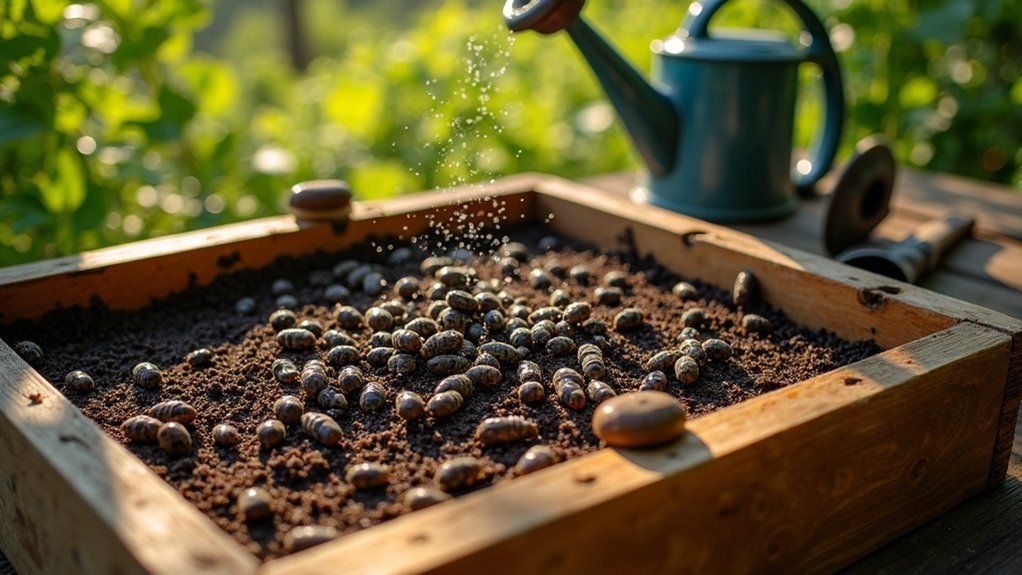
To build a Black Soldier Fly (BSF) bin suitable for survivalist and prepping scenarios, start with an 18-gallon tote, ensuring it has proper drainage using PVC pipe and fittings. This will help prevent water accumulation, which could attract unwanted pests. Incorporate corrugated cardboard as a substrate for egg-laying, providing a natural environment for the flies. Create ramps within the bin to facilitate larvae migration, aiding in their growth and ease of harvesting.
Maintain humidity levels between 50-70% to sustain healthy larvae development while also preventing any unpleasant odors that could compromise your prepping space. For optimal protein production in a survival context, feed approximately 4 pounds of organic waste daily for every 10,000 larvae. Regularly harvest the larvae every 20 days and keep an eye out for overcrowding, which can lead to stress and reduced growth rates. Understanding the ideal care and feeding practices for your BSF larvae can be crucial for maintaining a sustainable protein source in your prepping efforts.
Key Takeaways
- Use an 18-gallon tote as the main housing for your Black Soldier Fly (BSF) bin, ensuring that it includes proper ventilation and drainage to prevent moisture buildup, which can attract unwanted pests.
- Construct ramps using PVC pipe and fittings to facilitate the larvae’s migration for easy harvesting, an important step in utilizing your resources efficiently in a survival scenario.
- Incorporate corrugated cardboard as a substrate where adult BSF can lay their eggs, maximizing your bin’s productivity and ensuring a sustainable source of protein in times of need.
- Maintain moisture levels and humidity between 50-70% relative humidity (RH) to encourage healthy larvae growth while preventing foul odors, which is crucial for maintaining a clean and functional environment.
- Regularly monitor your food supply, aiming to provide approximately 4 pounds of organic waste daily for every 10,000 larvae, ensuring you have a continuous cycle of larvae ready for harvest to bolster your food supply in a prepping situation.
What Is a Black Soldier Fly (BSF)
The Black Soldier Fly (BSF) is an invaluable insect for survivalists and preppers, particularly in the realm of organic waste management.
Native to the neotropics, these remarkable insects mimic wasps in appearance but don’t feed as adults; their primary focus is on reproduction. They lay eggs that hatch into larvae, which are exceptional decomposers.
BSF larvae can consume up to 200 mg of organic waste daily, significantly decreasing its volume while enriching the nutrient content of compost. After around 21 days, you can harvest nutrient-rich soil, which can be vital for sustainable food production in a self-sufficient lifestyle.
BSF larvae efficiently consume organic waste, transforming it into nutrient-rich soil for sustainable self-sufficient living.
This natural recycling process not only helps manage waste effectively but also enhances your ability to maintain a resilient and sustainable homestead.
How To Care For BSF Larvae
Caring for BSF (Black Soldier Fly) larvae is crucial for those interested in self-sufficiency and sustainable living. Proper management of their environment and diet is essential for optimal growth and development. Use a substrate like coconut coir or coffee grounds, ensuring it maintains adequate moisture levels to support healthy larvae. A balanced diet consisting of food waste and organic matter is vital—aim to feed about 4 pounds per 10,000 larvae each day.
Keep humidity within the range of 50-70% RH to prevent unpleasant odors and microbial issues that could compromise your larvae. Regular monitoring for overcrowding or insufficient food is necessary, as these factors can significantly hinder growth and productivity.
| Aspect | Recommendation |
|---|---|
| Substrate | Coconut coir, coffee grounds |
| Humidity | 50-70% RH |
| Feeding Rate | 4 lbs/10,000 larvae/day |
| Check Frequency | Regularly assess needs |
What Can I Feed The BSF?
Feeding BSF (Black Soldier Fly) larvae is crucial for ensuring their growth and development, particularly for those involved in survivalism and prepping. A well-rounded diet can significantly enhance your BSF farming efforts, which can be a vital part of your sustainable food source strategy.
Here are three excellent food sources for BSF larvae that align with prepping principles:
- Organic Wastes: Utilize table scraps and restaurant leftovers as a means to minimize waste while maximizing resource efficiency. These organic materials can provide essential nutrients for your larvae and help you maintain a self-sufficient food system.
- Animal Products: Incorporating livestock manure isn’t only a great nutrient source but also enhances the efficiency of composting. This can be particularly useful for preppers looking to create a closed-loop system that reduces reliance on external inputs.
- Spent Coffee Grounds: These can be a valuable addition to your BSF larvae’s diet, offering extra nutrients and contributing to a varied food source. They’re often readily available and can be repurposed from daily use.
To maintain healthy and thriving larvae, aim for approximately 4 pounds of food daily for every 10,000 BSF maggots. This practice not only supports your BSF farming efforts but also aligns with the principles of sustainability and self-reliance that are essential in prepping.
How Do I Harvest My Bin?
How can you effectively harvest your Black Soldier Fly (BSF) bin to support your survivalist practices?
Wait about 20 days after adding food, as Black Soldier Fly larvae naturally migrate to pupate, which is crucial for your sustainable food source.
Allow around 20 days post feeding for Black Soldier Fly larvae to migrate, ensuring a reliable sustainable food source.
Place collection buckets at the bin’s exit points, ensuring ramps are accessible for easy access during your prepping routines.
Harvest every 20 days, but be sure to leave some feed and larvae to maintain ongoing soldier fly composting, which can be vital for your self-sufficiency.
Regularly monitor the bin to prevent excess moisture, as this can hinder harvesting and negatively affect the health of your larvae.
The resulting digestate can serve as a nutrient-rich soil amendment for your survival garden, but remember to test its quality for salt levels before application to ensure optimal plant growth.
Materials and Tools Required
To effectively build a Black Soldier Fly (BSF) bin for your survivalist or prepping endeavors, you’ll need specific materials and tools that ensure durability and functionality. Here’s a concise list to guide your construction:
- 18-gallon tote: Functions as the main structure for housing the BSF, ideal for resource conservation.
- PVC pipe and fittings: Crucial for drainage and creating ramps that allow larvae to escape, enhancing your food production system.
- Corrugated cardboard: Offers a substrate for egg-laying, ensuring a continuous cycle of larvae for protein supplementation.
Additionally, gather necessary tools such as a circular saw or handsaw, drill, screws (1.5-inch and 3-inch), caulk, a marker for precise measurements, and a gallon bucket for efficiently harvesting larvae.
This setup not only aids in waste management but also provides an essential food source in a prepping context.