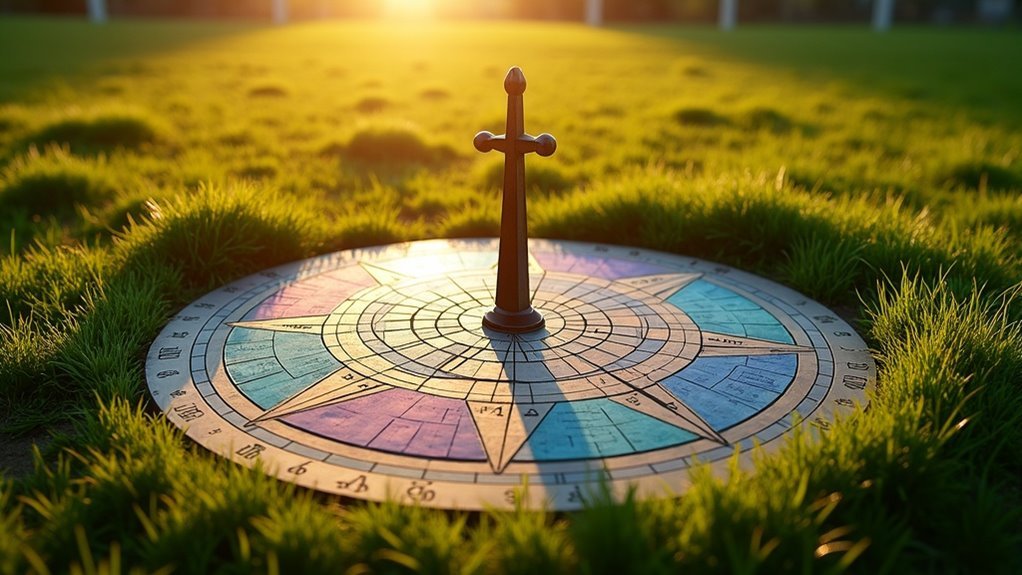
To create an analemmatic sundial, it is essential to understand the sun’s declination and seasonal changes, which can be crucial for survival situations. Start by designing an ellipse with a semi-major axis ranging from 6 to 8 feet, and calculate the semi-minor axis based on your geographical latitude. Next, construct the sundial by establishing true north and employing the string method to draw your ellipse accurately. Mark hour points, ensuring to adjust for Daylight Savings Time, which is vital for accurate timekeeping when planning daily tasks in a survival scenario. Ensure that the shadow aligns precisely throughout the day to provide reliable time readings, an important aspect when coordinating activities or monitoring essential routines in prepping. Explore additional details to optimize your sundial’s functionality for your survival needs.
Key Takeaways
- Determine the semi-major axis (M) for your sundial, typically between 6 to 8 feet, and calculate the semi-minor axis (m) using m = M sin(phi). This ensures your sundial is appropriately sized for survival situations where timekeeping may be crucial.
- Establish true north by drawing a North-South meridian line, ensuring accurate alignment for timekeeping. Knowing your direction can be vital in navigation and situational awareness.
- Use the string method and two pins at the foci to draw the ellipse, maintaining precision in shadow casting. A well-crafted sundial can provide a reliable time source during extended periods outdoors.
- Mark hour indicators based on calculated hour angles, adjusting for solar declination to ensure accurate time readings. This can aid in planning activities or movements throughout the day.
- Test the sundial throughout the day, adjusting the gnomon and hour markers as necessary for optimal functionality. Regular checks will help ensure you can depend on your sundial for time management in survival scenarios.
What Is an Analemmatic Sundial?
An analemmatic sundial is an intriguing timekeeping device that can be valuable for survivalists and preppers who want to harness natural elements for practical use. This instrument utilizes the sun’s position to tell the time of day, an essential skill when traditional methods may fail.
It consists of a vertical gnomon aligned along the North-South axis, with hour points arranged in an ellipse around it. These hour points are meticulously calculated based on the sun’s declination and your specific latitude, allowing for accurate time readings throughout the year—crucial during emergency situations.
The mathematical representation of the ellipse is given by the formula (frac{x^2}{a^2} + frac{y^2}{b^2} = 1), where the major axis runs East-West. This design relies on the casting of shadows, with a movable gnomon that can adapt to seasonal changes, ensuring precision.
In a survival scenario, understanding how to construct and use an analemmatic sundial can provide a reliable method for tracking time without the need for batteries or technology.
Understanding the Sun’s Declination
Understanding the sun’s declination is crucial for survivalists and preppers, especially when it comes to using an analemmatic sundial in outdoor settings. The declination angle affects how shadows are cast throughout the year, which can help you determine the time of day without relying on conventional timepieces. This knowledge can be vital in situations where resources are scarce or when you need to navigate using natural indicators.
The declination angle varies due to Earth’s axial tilt, reaching +23.44° at the summer solstice, 0° at the equinoxes, and -23.44° during the winter solstice. Understanding this variation is important for accurately marking hour points on your sundial and can aid in timekeeping during emergencies.
| Event | Declination Angle |
|---|---|
| Summer Solstice | +23.44° |
| Spring Equinox | 0° |
| Fall Equinox | 0° |
| Winter Solstice | -23.44° |
Designing the Ellipse
Designing an analemmatic sundial can be a crucial skill for survivalists and preppers, as it offers a reliable way to tell time without modern technology.
Start by determining your semi-major axis (M), typically between 6 to 8 feet, to ensure visibility and accuracy. Calculate the semi-minor axis (m) using the formula m = M sin(phi), where phi is your latitude. For example, at 40° N, if M is 6 feet, m equals approximately 3.86 feet.
To draw the ellipse, fix two pins at the foci, determined by F_1 = -sqrt{M^2 – m^2} and F_2 = +sqrt{M^2 – m^2}. This method guarantees precise shadow casting throughout the day, allowing you to keep track of time effectively in any survival scenario.
Constructing the Analemmatic Sundial
To construct your analemmatic sundial, you’ll need specific tools and materials that are essential for survival and prepping, such as durable pins, strong string, chalk for marking, and a reliable measuring device.
Follow a step-by-step construction process that includes marking the ellipse and positioning the hour indicators based on calculated angles.
Accuracy in marking these hour points is crucial for ensuring your sundial functions correctly throughout the day, providing you with an alternative timekeeping method that can be invaluable in a survival situation.
Required Tools and Materials
Constructing an analemmatic sundial can be a valuable skill for survivalism and prepping, providing a reliable method to tell time using natural sunlight.
To ensure precision and functionality, you’ll need specific tools and materials. A measuring tape or yardstick is essential for accurately measuring distances. An unstretchy string, approximately 22 feet long, is crucial for defining the elliptical shape of the sundial. A right angle tool, such as a carpenter’s square, will help you secure correct angles for your construction.
Chalk is important for initial layout drawings, allowing for easy adjustments before making any permanent markings. To determine true north, a magnetic compass is necessary, but be sure to account for magnetic declination in your area. A pin can serve as a representation of the foci during the drawing process, enhancing the accuracy of your sundial.
Optional tools include paint for creating lasting markings and a computer for designing your sundial layout. This knowledge can be a useful addition to your survival toolkit, helping you stay informed about the time even without modern technology.
Step-by-Step Construction Process
Once you’ve gathered your survival tools and materials, the construction of your analemmatic sundial begins with establishing true north, which is crucial for accurate timekeeping in outdoor survival situations.
Draw the North-South meridian line, ensuring it intersects the East-West line at a right angle. Calculate the minor axis length (m = M sin(phi)), which can help in determining the dimensions of your sundial.
Use a string method to draw the ellipse, fixing two pins at the foci and tracing with chalk or a natural pigment. Mark hour points around the ellipse by calculating the hour angle (H), applying x = M sin(H) and y = M sin(phi) sin(H).
Finally, position the movable gnomon along the North-South line to ensure accurate shadows are cast for timekeeping, aiding you in planning your survival tasks throughout the day.
Marking Hour Indicators Accurately
Accurate placement of hour indicators on your analemmatic sundial is essential for precise timekeeping, especially when considering survival scenarios where reliable timekeeping can aid in navigation and planning. Calculate the hour angle (H) for each hour, adjusting for solar declination to ensure your sundial is functional in various outdoor settings. Use the formulas ( x = M sin(H) ) and ( y = M sin(phi) sin(H) ) to determine the x and y coordinates for your hour marks. Make sure the indicators are symmetrically spaced around the ellipse, adjusting based on where the shadow falls to maximize their effectiveness. Test the sundial throughout the day to confirm accuracy and make adjustments if necessary, as having an accurate time source can be crucial in emergency situations.
| Hour | Hour Angle (°) | x, y Coordinates |
|---|---|---|
| 6 AM | -90 | (x1, y1) |
| 9 AM | -45 | (x2, y2) |
| 12 PM | 0 | (x3, y3) |
| 3 PM | 45 | (x4, y4) |
| 6 PM | 90 | (x5, y5) |
Laying Out the Hour Points
To effectively lay out the hour points on your analemmatic sundial, you need to establish the major and minor axes based on your geographic location, which can be crucial in survival situations.
The major axis runs East-West, while the minor axis is calculated using the formula ( m = M sin(phi) ).
For each hour, mark points along the ellipse perimeter by calculating the hour angle ( H ) as ( 15 ) degrees times the hours past noon.
Use the formulas ( x = M sin(H) ) and ( y = M sin(phi) sin(H) ) to determine accurate coordinates.
This knowledge can help you gauge time without relying on modern devices, an essential skill in prepping and self-sufficiency.
Verify hour markings are symmetrical for precise time reading throughout the day, ensuring you can plan your activities effectively in any survival scenario.
Adjusting for Daylight Savings
To effectively adjust your analemmatic sundial for Daylight Savings Time (DST) while embracing your survivalism and prepping mindset, you’ll need to shift the hour markings forward by one hour during the DST period.
It’s crucial to ensure the gnomon’s alignment with the North-South meridian to maintain reliable timekeeping after these adjustments.
Additionally, for enhanced accuracy in your solar time readings, consider utilizing the Equation of Time to account for any discrepancies.
This knowledge can be invaluable in a survival situation where precise timekeeping is essential.
Understanding Daylight Savings Time
While understanding Daylight Savings Time (DST) is essential for accurate timekeeping in survival situations, it’s important to recognize how the biannual clock adjustments can affect your preparedness strategies.
When relying on a sundial as a timekeeping tool in the great outdoors, you must adjust your hour markings to account for DST, as the one-hour shift can lead to discrepancies in your time calculations. This recalibration ensures that your sundial accurately reflects solar time, which is crucial for planning tasks such as foraging or setting up camp.
Additionally, be sure to indicate whether your hour markers reflect standard time or DST to prevent confusion during crucial moments. Being aware of DST’s impact will enhance your survival experience, allowing you to make informed decisions based on accurate time readings throughout the year.
Adjusting Hour Markings
Adjusting hour markings on your analemmatic sundial for daylight savings time is crucial for ensuring accurate time readings, especially in the context of survivalism and prepping. Shift the hour markers forward by one hour when daylight savings is in effect, and ensure the gnomon’s position is recalibrated accordingly to maintain functionality. When daylight savings ends, revert the hour markers to their original positions to reflect standard time. It’s essential to clearly label the sundial with “Standard Time” and “Daylight Savings Time” to avoid confusion in emergency situations. Use the following correction table for your adjustments:
| Change Date | Action | New Position |
|---|---|---|
| March (Spring) | Move forward 1 hour | Adjusted |
| November (Fall) | Move back to original hour | Reverted |
| Yearly Reminder | Check for adjustments | Maintain accuracy |
Keeping your sundial accurate is a key component of preparedness, aiding in time management during critical situations.
Seasonal Time Corrections
Seasonal time corrections are crucial for ensuring the accuracy of your analemmatic sundial, especially in the context of survivalism and prepping during the transitions into and out of Daylight Savings Time.
To make the necessary adjustments, add one hour to the sundial’s time during the months of Daylight Savings. It’s advisable to clearly mark these seasonal changes on your sundial to improve user comprehension, which is vital in emergency situations.
Consider implementing two sets of hour markings: one for standard time and another for Daylight Savings Time, allowing for quick adjustments as conditions change.
Additionally, keep in mind the Equation of Time, as it can impact the precision of your timekeeping.
Regularly recalibrating your sundial around the Daylight Savings transitions, which typically occur on the second Sunday in March and the first Sunday in November, will ensure that you can always rely on it for accurate timekeeping, a key aspect of effective preparedness.
Testing and Using the Sundial
How can you ensure your analemmatic sundial is a reliable tool for survival and prepping? Start by testing the sundial in a practical environment; position the gnomon vertically along the North-South axis and observe the shadow it casts throughout the day.
Confirm it aligns with the hour markings to ensure you can effectively track time during critical survival tasks. Adjust for the Equation of Time using mathematical corrections based on the date to enhance precision, which can be vital in time-sensitive situations.
Be aware that local solar time may differ, necessitating further adjustments. Regularly compare the sundial’s time with a reliable clock to maintain accuracy, especially during emergency scenarios.
Document its performance over a week, noting any discrepancies to refine your adjustments for future use. This systematic approach will significantly enhance the reliability of your sundial readings in survival situations.